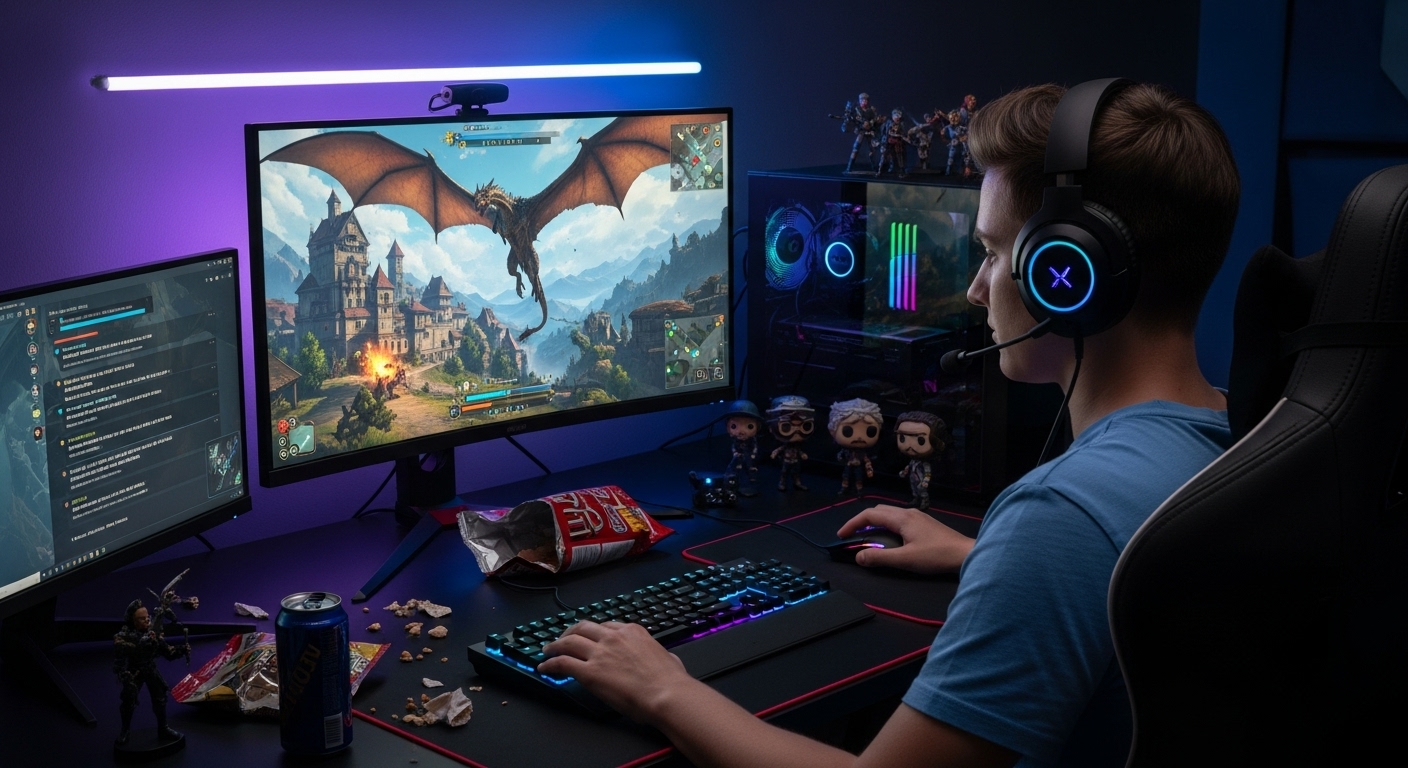
Video gaming has undergone a dramatic transformation since its inception, evolving from simple pixelated screens to highly detailed, immersive worlds that captivate millions around the globe. In the past few decades, gaming has gone from being a niche hobby to a multi-billion-dollar industry, influencing culture, technology, and even education. In this blog post, we will explore the fascinating journey of video games, starting from the humble beginnings of arcade machines to the expansive realms of modern virtual reality (VR) and online multiplayer experiences. We’ll dive deep into the major milestones, innovations, and challenges that have shaped the gaming industry, and examine where gaming is heading in the future.
The Birth of Video Games: The 1950s to 1970s
The history of video games begins not with a focus on entertainment, but rather with early experiments in technology. In the 1950s and 1960s, computers were still a new concept, and their primary use was for scientific and military purposes. However, a few forward-thinking individuals began to realize that these machines could be used for interactive entertainment.
One of the earliest examples of interactive gaming was Tennis for Two, created in 1958 by William Higinbotham, a physicist at the Brookhaven National Laboratory. This simple tennis simulation was displayed on an oscilloscope, allowing players to control paddles and “hit” a ball back and forth. While it was not a commercially successful game, it was a precursor to the types of games that would later emerge.
The first true commercial video game came in 1972 with the release of Pong, created by Atari’s Nolan Bushnell. Pong was a simple two-player simulation of table tennis, where players used paddles to bounce a ball back and forth on a screen. Despite its simplicity, the game was an immediate hit and quickly spread to arcades around the world. This marked the birth of the arcade gaming industry.
By the mid-1970s, arcades were filled with various titles like Space Invaders (1978) and Asteroids (1979), which continued to push the boundaries of interactive gaming. As arcade culture grew, home gaming consoles also began to emerge, starting with the release of the Atari 2600 in 1977. The Atari 2600 allowed players to purchase interchangeable cartridges, marking the beginning of the home gaming console era.
The Golden Age of Arcades and the Rise of Home Consoles: The 1980s
The 1980s are widely considered the “Golden Age” of arcade gaming. This era saw a surge in the popularity of video games, with titles like Space Invaders, Pac-Man, Donkey Kong, and Galaga dominating the arcades. These games were simple but incredibly addictive, offering players an opportunity to challenge their skills and compete for high scores.
Space Invaders (1978), in particular, was a revolutionary game, as it introduced the concept of shooting waves of enemies with increasing difficulty. Its success led to a slew of copycat titles, helping to establish the arcade as the place to be for entertainment during the 1980s. Pac-Man (1980) brought a new level of accessibility to video games, with its non-violent gameplay and colorful graphics. It quickly became a cultural phenomenon, with its main character, Pac-Man, becoming an iconic symbol of gaming.
However, while arcades were thriving, the home console market was also taking shape. In 1985, Nintendo released the Nintendo Entertainment System (NES), which would go on to become one of the most influential consoles in gaming history. The NES helped to solidify Nintendo as a leading player in the gaming industry, with hit titles like Super Mario Bros., The Legend of Zelda, and Metroid.
During the 1980s, the industry faced its first major crash. The video game crash of 1983 was caused by an oversaturation of the market, poor-quality games, and the rapid failure of companies like Atari. Despite this, Nintendo’s NES helped to revive the home console market, ushering in a new era of gaming that would focus on quality, innovation, and long-lasting franchises.
The Rise of 3D and the Impact of CD-ROMs: The 1990s
The 1990s marked a turning point in the gaming world. The decade introduced the shift from 2D to 3D graphics, as well as the introduction of CD-ROMs, which dramatically increased the storage capacity of games. These innovations led to the creation of expansive game worlds and cinematic experiences, setting the stage for modern gaming as we know it.
Sony’s PlayStation, released in 1994, was one of the most influential consoles of the 1990s. Unlike previous systems, the PlayStation used CDs instead of cartridges, which allowed for larger, more detailed games. Titles like Final Fantasy VII (1997) and Metal Gear Solid (1998) showcased the PlayStation’s power, offering players immersive, story-driven experiences that would become a hallmark of gaming in the years to come.
Meanwhile, Nintendo released the Nintendo 64 in 1996, which introduced the world to fully 3D platforming with games like Super Mario 64 (1996). This was one of the first games to use the 3D capabilities of the console in a way that felt natural, with open-world exploration and camera control becoming standard in the genre. The Nintendo 64 also introduced the now-ubiquitous analog stick, which allowed for precise movement in 3D space.
On the PC side, the 1990s saw the rise of real-time strategy games (RTS) and first-person shooters (FPS). Games like Warcraft II (1995) and StarCraft (1998) helped establish RTS games as a dominant genre, while Doom (1993) and Quake (1996) defined the FPS genre. These games pushed the boundaries of multiplayer gaming, with Quake in particular being one of the first games to allow players to battle against each other over the internet.
The 1990s were also a time when online gaming began to take off. The advent of dial-up internet connections allowed players to connect with others over the web, and games like Doom and Quake laid the foundation for the modern multiplayer gaming scene.
The 2000s: The Era of Online Gaming and the Rise of Esports
The early 2000s saw online gaming evolve from a niche activity into a dominant force in the industry. Broadband internet became more widespread, making it easier for players to connect and engage with each other in real-time. The 2000s were also marked by the rise of massively multiplayer online role-playing games (MMORPGs), which allowed thousands of players to interact in a shared, persistent virtual world.
World of Warcraft (2004), in particular, became a cultural phenomenon, with millions of players worldwide participating in its expansive fantasy universe. MMORPGs like World of Warcraft created an entirely new type of social experience, where players could form guilds, participate in raids, and explore vast virtual worlds.
In the console market, the Xbox 360 (2005) and PlayStation 3 (2006) were released, bringing advanced graphics, online multiplayer functionality, and digital media services to the forefront. Microsoft’s Xbox Live service was a game-changer, offering online multiplayer gaming for the first time on a console. It was during this era that online games like Halo 3 (2007) and Call of Duty 4: Modern Warfare (2007) became synonymous with competitive multiplayer gaming.
The rise of esports also began in the 2000s, with competitive gaming leagues and tournaments starting to gain traction. StarCraft tournaments in South Korea, for example, became massive events, and the early stages of esports as we know it today were established. By the end of the decade, esports was attracting large audiences both in-person and via online streaming platforms like Twitch, marking the beginning of a global esports phenomenon.
The 2010s: The Growth of Mobile Gaming and Virtual Reality
The 2010s were a transformative decade for video games, with mobile gaming, virtual reality (VR), and live-streaming all taking center stage. Mobile gaming exploded in popularity, thanks in large part to the rise of smartphones. Games like Angry Birds (2009), Candy Crush Saga (2012), and Clash of Clans (2012) reached millions of players, many of whom had never considered themselves gamers before. Mobile gaming became more than just a passing trend; it became a mainstream form of entertainment.
At the same time, virtual reality (VR) gaming began to gain serious traction. The Oculus Rift, HTC Vive, and PlayStation VR all brought virtual reality to consumers, offering immersive gaming experiences that allowed players to physically interact with virtual worlds. While the technology was still in its early stages, VR offered a glimpse of the future of gaming, with immersive environments and new ways to interact with games.
The 2010s also saw the rise of live-streaming as a dominant form of entertainment. Platforms like Twitch and YouTube Gaming allowed players to broadcast their gameplay to millions of viewers, creating an entirely new way to experience games. Esports grew into a billion-dollar industry during this time, with games like League of Legends, Dota 2, and Overwatch attracting huge audiences and offering significant cash prizes for competitive players.
The Future of Gaming: Cloud Gaming, AI, and the Metaverse
Looking to the future, the gaming industry shows no signs of slowing down. One of the most promising developments is cloud gaming, which allows players to stream games from remote servers instead of relying on high-end consoles or PCs. Services like Google Stadia, Xbox Cloud Gaming, and NVIDIA GeForce Now are pushing the boundaries of how we experience games, making it possible to play AAA titles on smartphones, tablets, or low-cost devices.
Artificial intelligence (AI) is also poised to transform gaming. With more advanced AI, games could become even more dynamic and interactive, offering experiences that adapt to a player’s actions and decisions. AI could also be used to create more lifelike NPCs (non-playable characters) and procedural environments that change based on player behavior.
Another exciting possibility is the rise of the Metaverse, a fully immersive digital universe that could combine gaming, social interaction, and even work. The Metaverse, powered by technologies like VR, AR, and blockchain, could allow players to experience games in ways that are more integrated into their daily lives, blurring the line between reality and the virtual world.
Conclusion: Gaming’s Bright Future
The journey of video gaming, from its humble beginnings to its current status as a global cultural force, is nothing short of remarkable. Over the decades, gaming has evolved from a niche hobby to a mainstream form of entertainment that influences everything from technology to social dynamics. As the industry continues to innovate, the future of gaming looks incredibly bright, with advancements in cloud gaming, artificial intelligence, virtual reality, and the Metaverse all on the horizon. Whether you’re an avid gamer or someone who enjoys the occasional game, the world of video games will undoubtedly continue to captivate and inspire for many years to come.