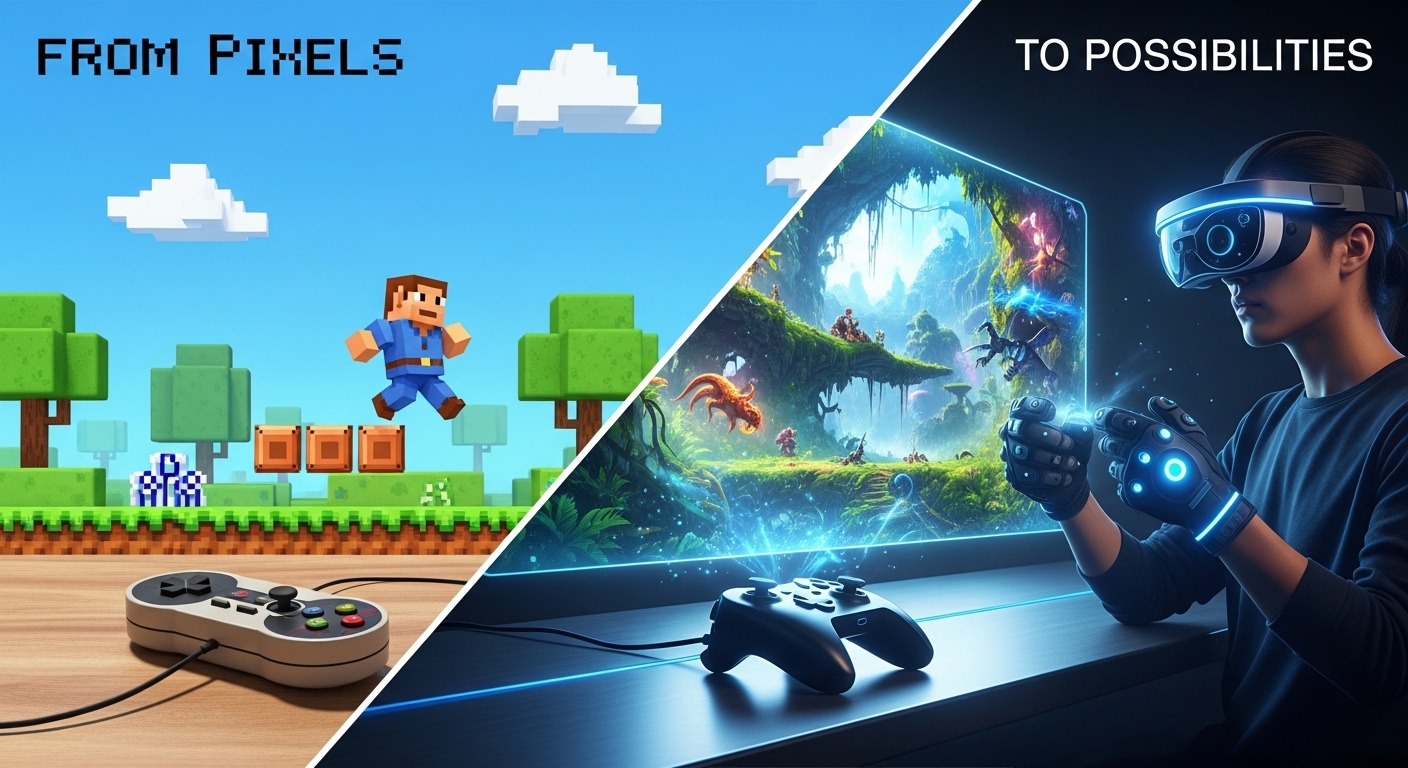
Video gaming is one of the most influential and dynamic forms of entertainment in the world today. It has transformed from a niche hobby to a global industry, earning billions of dollars annually and shaping the culture, technology, and social experiences of millions of people. The evolution of gaming is a fascinating journey, marked by significant technological advancements, cultural shifts, and the rise of gaming as a competitive and spectator-driven activity. This post delves into the history, impact, and future of gaming, highlighting its incredible growth and transformation from simple arcade machines to the immersive experiences of today.
The Dawn of Video Games: The Birth of a New Medium
The origins of video gaming can be traced back to the late 1950s and early 1960s, during a time when computing was still in its infancy. The first instances of interactive entertainment came from the world of academic and scientific experiments rather than entertainment. In 1958, William Higinbotham, a physicist at the Brookhaven National Laboratory, created Tennis for Two, a game displayed on an oscilloscope. Although the game was very rudimentary, it introduced the concept of interactive gameplay, a key element of what would become the video gaming industry.
However, the true beginning of commercial video gaming can be traced to 1972, when Pong, created by Nolan Bushnell and Atari, was released. It was one of the first successful arcade games and became an instant sensation. A simple simulation of table tennis, Pong drew crowds of people into arcades, giving rise to a new form of entertainment. Its success led to the opening of the first arcades, where people could pay to play games on arcade cabinets.
The 1970s also saw the introduction of home consoles, with the Atari 2600 being the first major console to use interchangeable cartridges, allowing players to enjoy different games without needing separate machines. The console’s success in the late 1970s and early 1980s helped lay the groundwork for home gaming as we know it today.
The Golden Age of Arcades: The 1980s and the Rise of Home Consoles
The 1980s are often referred to as the “Golden Age” of arcade games, a period in which gaming was at its cultural peak in terms of social impact. The rise of games like Space Invaders (1978), Pac-Man (1980), and Donkey Kong (1981) made video games mainstream entertainment. These games were simple in design but highly addictive, captivating players with their easy-to-learn yet difficult-to-master mechanics.
Pac-Man is particularly significant in this era because it expanded the appeal of video games beyond traditional audiences. Unlike earlier games, which were often focused on shooting or action, Pac-Man involved strategy and puzzle-solving, attracting a more diverse group of players, including women. The game became a global cultural phenomenon, with Pac-Man characters appearing on merchandise, cartoons, and even the first video game-inspired music hits.
The 1980s also saw the emergence of Nintendo as a major player in the gaming industry. In 1985, Nintendo released the Nintendo Entertainment System (NES), a home console that would change the trajectory of gaming. The NES featured legendary games like Super Mario Bros., The Legend of Zelda, and Metroid, many of which became franchises that would last for decades. Nintendo’s success also ushered in a new era of home console gaming, as the NES revitalized the industry following the video game crash of 1983.
However, the arcade experience continued to thrive in the 1980s. Arcades became social hubs where players could interact, compete, and compare high scores. This was the golden age of arcade culture, where video game competitions and tournaments were born, and where the first icons of gaming, like Mario and Donkey Kong, were created.
The 1990s: The Shift to 3D, CD-ROMs, and the Explosion of Personal Computers
The 1990s brought about a major shift in video game technology, moving from 2D pixel-based graphics to fully realized 3D environments. This change was driven by advancements in hardware, particularly in the processing power of both gaming consoles and personal computers. The introduction of 3D graphics would go on to revolutionize the way games were played and designed, with new genres and possibilities opening up.
One of the most influential consoles of the 1990s was Sony’s PlayStation, which launched in 1994. The PlayStation was a game-changer because it used CDs instead of cartridges, which allowed for greater storage capacity and more complex games. Titles like Final Fantasy VII (1997) and Metal Gear Solid (1998) helped showcase the PlayStation’s capabilities, offering expansive worlds and cinematic storytelling. The ability to store larger amounts of data on CDs also led to the rise of game franchises that could be experienced in chapters or episodic formats, adding a new layer of depth to gaming narratives.
During the same period, Nintendo released the Nintendo 64 in 1996, which further advanced the transition to 3D gaming. Super Mario 64 (1996), the flagship game for the console, set the standard for 3D platformers, offering players an open-world experience with fully 3D-rendered environments. Mario 64 revolutionized how players interacted with game worlds, allowing them to move freely in a 3D space for the first time.
On the personal computer front, the 1990s saw the rise of first-person shooters (FPS) and real-time strategy (RTS) games, largely due to improvements in PC hardware. Games like Doom (1993), Warcraft II (1995), and StarCraft (1998) introduced new types of gameplay, where players could engage in combat in real-time and control entire armies or teams. These games laid the foundation for multiplayer experiences, setting the stage for the online gaming boom in the years to come.
In the realm of PC gaming, the introduction of LAN parties (Local Area Network) further changed the landscape of gaming. Gamers would set up multiple PCs in a single location to play multiplayer games like Quake and Unreal Tournament (1999), helping to establish the importance of multiplayer gaming in the coming years.
The 2000s: Online Gaming, Broadband, and the Rise of Esports
The early 2000s saw the rapid expansion of online gaming, fueled by the rise of broadband internet and the growing popularity of multiplayer games. The ability to play against others over the internet opened up new possibilities for gaming, and developers quickly began designing games with online play as a core feature.
One of the most significant developments of this era was the launch of Microsoft’s Xbox Live service in 2002. Xbox Live allowed Xbox owners to connect to the internet and play games online, with Halo 2 (2004) being one of the first major titles to benefit from this feature. Online multiplayer games became the norm, with franchises like Call of Duty and World of Warcraft dominating the gaming landscape.
World of Warcraft (2004) became a global phenomenon, attracting millions of players into its expansive, multiplayer fantasy world. It was one of the first games to successfully create a persistent online universe where players could interact, form guilds, and embark on quests together. World of Warcraft set the stage for MMORPGs (massively multiplayer online role-playing games) to become a dominant genre and further solidified the online gaming community.
The 2000s also marked the rise of competitive gaming, or esports. Games like StarCraft, Counter-Strike, and Warcraft III became staples in competitive tournaments, and by the late 2000s, esports events began attracting large audiences. The introduction of streaming platforms like Twitch in 2011 allowed fans to watch live broadcasts of esports competitions, creating a new avenue for professional gamers to build careers. The rise of esports signaled a shift in the gaming culture, where gaming was no longer just for fun but also a competitive and spectator-driven activity.
The 2010s: Mobile Gaming, Virtual Reality, and the Growth of Live Streaming
The 2010s saw gaming further integrate itself into mainstream culture. Mobile gaming, which had always been around in some form, exploded with the advent of smartphones and tablets. Games like Angry Birds (2009), Candy Crush Saga (2012), and Clash of Clans (2012) became household names, reaching millions of players who may never have identified as traditional gamers. Mobile gaming shifted the industry towards a more casual audience, with freemium models and microtransactions becoming a significant part of the gaming experience.
At the same time, consoles like the PlayStation 4 (2013) and Xbox One (2013) continued to push the boundaries of gaming, offering stunning graphics, complex game worlds, and seamless online play. Exclusive titles like The Last of Us (2013) and Red Dead Redemption 2 (2018) raised the bar for storytelling and cinematic experiences in gaming, showing that video games could deliver rich, emotional narratives on par with Hollywood films.
Virtual Reality (VR) began to gain momentum in the 2010s as well. Devices like the Oculus Rift (2016) and PlayStation VR (2016) introduced players to fully immersive gaming experiences, where they could interact with virtual worlds using motion controllers. Although VR is still in its early stages, it represents a significant step forward in creating more immersive and interactive gaming environments.
The rise of live streaming continued to shape gaming culture, with platforms like Twitch and YouTube Gaming allowing gamers to share their experiences with large audiences. Esports grew exponentially during this time, with major tournaments like *